Zcash NU7 Upgrade: ZEC Mining Rewards, Fees and Sprout
Zcash NU7 activated on November 6, 2026, at mainnet block 3,543,405. The network now targets a block every 25 seconds, down from 75. For someone waiting to see a ZEC payment land, that means a shorter expected wait for the first confirmation. For someone running a miner, the headline is different: each block carries one-third of the previous subsidy, and the rules for collecting transaction fees have changed.
Zcash NU7 upgrade at a glance
Updated November 10, 2026. Zcash Network Upgrade 7 (NU7) is the consensus update activated at block 3,543,405. For miners, its most immediate effects are more frequent blocks, smaller subsidies per block and a new split of transaction fees. For holders of legacy Sprout funds, the practical consequence is that spending is unavailable under the active rules.
- Activation: November 6, 2026, at 02:34 UTC, or 10:34 in Hong Kong and Beijing.
- Block target: 25 seconds, with the scheduled subsidy scaled to one-third per block.
- Fee allocation: 40% goes to the current block producer and 60% enters the Network Sustainability Mechanism.
- Sprout: approximately 12,224.21 ZEC remains subject to the spending restriction.
The sections below separate protocol facts from illustrative calculations and practical operating guidance. Activation and balance figures are dated observations. ZecStats NU7 tracker.
What 25-second blocks look like over a day
Picture a pool operator watching the chain for five minutes. At the old target, the whole network would produce about four blocks in that window. At the new target, it would produce about twelve. A screen showing the latest block height should move more often, even if the pool has added no machines. Individual intervals still vary because finding a valid proof of work involves chance.
| Network measure | Before NU7 | After NU7 |
|---|---|---|
| Target time between blocks | 75 seconds | 25 seconds |
| Expected blocks per 24 hours at target | 1,152 | 3,456 |
| Scheduled subsidy per block, relative to the old rate | 1 | ⅓ |
The arithmetic explains why tripling yesterday’s mining revenue would give a misleading forecast. Three times as many blocks multiplied by one-third as much subsidy yields the same scheduled subsidy over a day. Actual pool credits can still move with the pool’s share of network work, fees, luck and payout method. A calculator that updates only the block interval will overstate the subsidy. One that updates only the reward per block will understate it.
Where the fees go under Zcash NU7
A block can pay its producer from two sources: newly issued ZEC and fees attached to transactions. NU7 treats those two amounts separately. Under the Network Sustainability Mechanism, 40% of transaction fees are available to the current block producer and 60% are set aside for future block rewards. That percentage applies to the transaction fees alone.
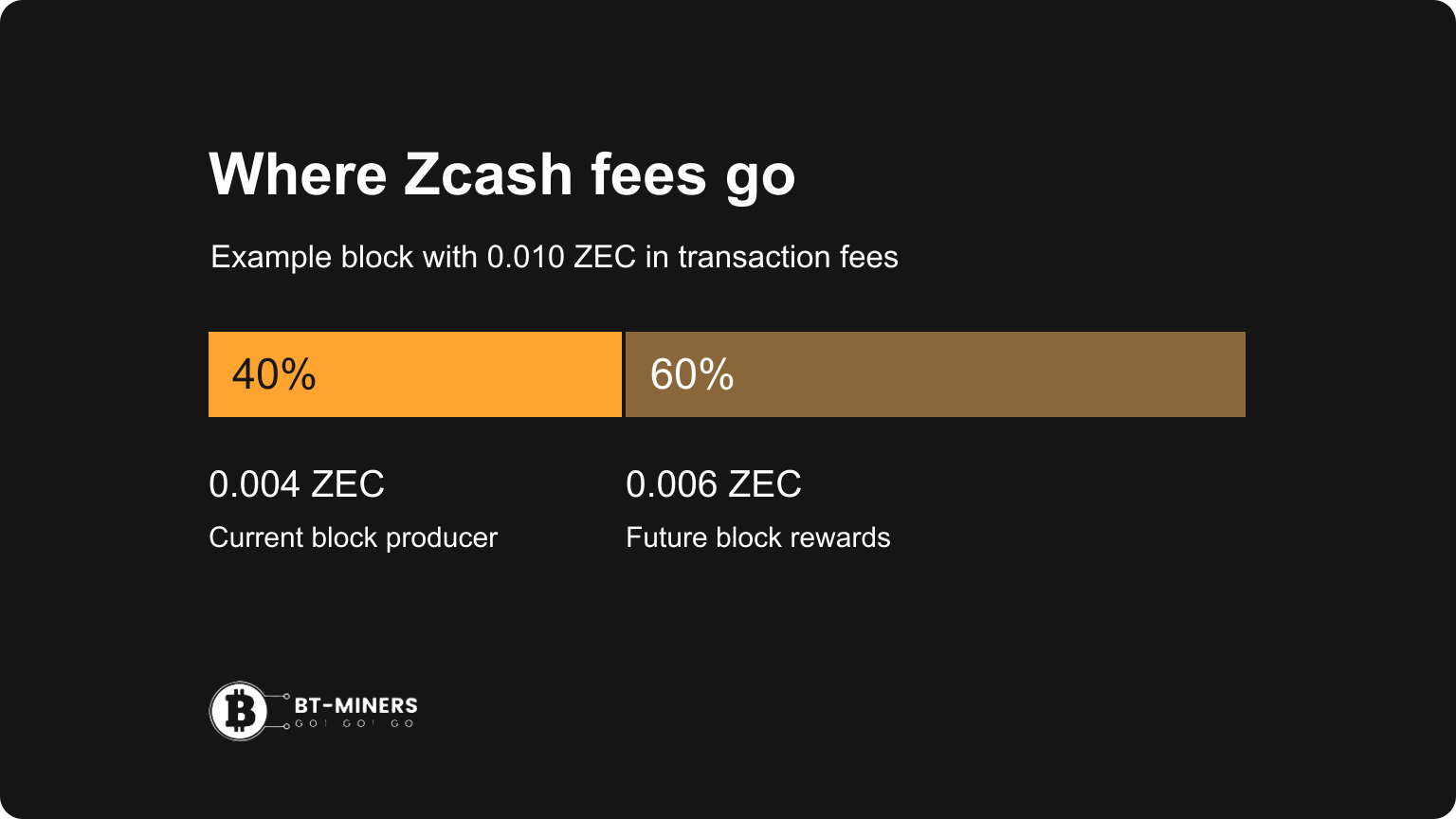
A pool can also charge its customers a service fee. That is a separate line in a miner’s accounts. To reconcile a payout, start with the pool’s published reward method and the work it credited to your account. Applying another 60% deduction to the entire payout would count the protocol rule against the wrong amount.
What to check on an existing ZEC mining rig
ZEC mining continues to use Equihash. The software that builds and validates blocks needs to understand NU7. For a pool customer, that software usually runs at the pool. For a solo miner operating a node, it runs on infrastructure the miner controls. The Zcash Foundation identified Zebra 7.0.0 as its first stable release with NU7 mainnet support.
- Pool customers: Check that the pool is following blocks above the activation height, then open your worker record. Compare accepted shares and stale or rejected shares with a comparable period before activation. A normal hashrate on the machine alone cannot tell you whether the pool credited its work.
- Solo miners and pool operators: Check the node version, compare its recent block hashes with an independent explorer and confirm that your software is issuing fresh jobs as the tip advances. A height that keeps rising is more informative when the corresponding block hash also agrees.
- Anyone checking a payout: Distinguish the pool’s payment schedule, the transaction’s first on-chain confirmation and the receiving service’s deposit policy. A pool that pays once a day can continue doing so even when blocks arrive more often.
What the change means for an ASIC buyer
Take the 840 kSol/s version of the Bitmain Antminer Z15 Pro. At its listed 2,780 W, a full day at rated power uses about 66.72 kWh. At an illustrative electricity rate of US$0.10 per kWh, that comes to US$6.67 per day before external cooling or hosting charges. Faster blocks change neither side of that electricity calculation.
For a useful post-upgrade comparison, record the ZEC credited over a full pool accounting period, the worker’s uptime and the electricity consumed over those same hours. A payout received today may include work from yesterday. Match the time windows before attributing a change to NU7. Buyers comparing hardware can use the BT-Miners ZEC miner collection and enter their own power rate in the product calculator.
How to evaluate ZEC mining income after NU7
Start with the amount of ZEC credited to your worker over a defined period. Multiply that amount by the price you could actually receive, then subtract electricity, hosting and other operating costs for the same period. Use pool credits after its service fee, or subtract that fee separately if you start with gross rewards. This avoids deducting the same charge twice.
For example, suppose a worker receives 0.010 ZEC over 24 hours and uses 66.72 kWh. These are hypothetical accounting inputs, not a forecast for any machine. At a valuation of US$1,000 per ZEC, gross revenue is US$10.00. At US$0.10 per kWh, electricity is US$6.672, leaving US$3.328 before other costs. At US$700 per ZEC, revenue falls to US$7.00 and that margin falls to US$0.328.
| Electricity price | Daily electricity at 66.72 kWh | Margin on hypothetical US$10 revenue |
|---|---|---|
| US$0.06/kWh | US$4.00 | US$6.00 |
| US$0.10/kWh | US$6.67 | US$3.33 |
| US$0.14/kWh | US$9.34 | US$0.66 |
Figures are rounded to cents and exclude cooling, maintenance, hardware cost and financing. The electricity-only break-even coin price in this example is US$6.672 divided by 0.010 ZEC, or US$667.20 per ZEC. A lower credited coin amount raises that threshold. Use your own payout history and meter readings when evaluating a purchase or hosting agreement.
Compare equivalent operating windows
Record the start and end time, accepted work, reject rate, credited ZEC and meter consumption for each observation. Compare complete accounting windows under the same payout method. An unusually lucky pool period can distort a short sample. For a buyer, several complete periods provide a more useful starting point than multiplying a single favorable hour by 24.
NU7 troubleshooting for miners and payout recipients
| What you observe | What to check next |
|---|---|
| Local hashrate looks normal but the pool reports no work | Check the configured endpoint, worker name, connection log and accepted-share counter. Confirm that the pool reports NU7 support. |
| Stale or rejected shares increased | Compare worker logs with connection interruptions, job changes and pool notices. Check latency and compare equivalent time windows before changing firmware. |
| A payout is marked sent but has not arrived | Obtain the transaction ID, check inclusion on-chain, then review the receiving service’s required confirmations and deposit status. |
| An older signed transaction is rejected | Check the transaction format and wallet support. NU7 rejects v4 transactions, including transactions prepared before activation. |
| A self-operated node disagrees with an explorer | Check software support and compare recent block hashes with more than one independent source before relying on its payment or mining records. |
These checks help narrow down the cause. A symptom alone does not identify which component failed. Keep the previous configuration and relevant logs so the pool or wallet developer can investigate a reproducible report. For equipment and facility planning, review BT-Miners hosting services alongside the electrical specifications of the chosen machine.
What faster blocks mean for payments and wallet workloads
The 25-second figure describes the network target. Payment usability also depends on transaction inclusion, wallet synchronization and the receiving service’s confirmation policy. A merchant evaluating the change should measure the entire interval from payment submission to the point at which its system credits the purchase.
ZIP 218 also introduces shielded-action limits, including a global budget and limits by shielded pool. These rules constrain the work a block can impose on wallets. The specification models improved throughput alongside a lower worst-case light-client synchronization burden. Application developers still need to measure their own workloads, device performance and payment flow. ZIP 218 block spacing and action limits.
How the Network Sustainability Mechanism supports future rewards
ZIP 235 specifies the removal of 60% of transaction fees from current circulation. ZIP 237 defines the algorithm for issuing the accumulated value through future subsidies while retaining the halving structure. This is a network-wide reward mechanism. A miner assessing current cash flow should use rewards credited today and treat future protocol issuance according to the rules in effect when that future work is performed. ZIP 235 fee allocation and ZIP 237 issuance rules.
Sprout funds after NU7 and the roughly 16 million dollar estimate
Update checked November 10, 2026. The activation block was mined on November 6 at 02:34 UTC, or 10:34 a.m. in Hong Kong and Beijing. ZecStats reports a Sprout balance of approximately 12,224.21 ZEC. At an illustrative US$1,300 per ZEC, that equals US$15,891,473, or about US$15.9 million. This calculation uses a stated price assumption. The dollar figure changes with the price used to value the coins. ZecStats activation and balance tracker.
Why a valid private key cannot currently move Sprout funds
ZIP 2003 disables all version 4 transactions from NU7 onward. Sprout spending requires that format, while versions 5 and 6 provide no Sprout transfer mechanism. A holder can possess the correct key yet remain unable to create a spend accepted under current consensus rules. The restriction also affects other workflows that still generate v4 transactions. ZIP 2003 specification.
What ZIP 2003 says about future access
The specification leaves recovery theoretically possible through a future consensus change, while warning that spending may never be restored. It supplies no recovery procedure or implementation timetable. The Sprout balance remains counted as issued supply. Holders should therefore treat access as unavailable today and any future recovery as uncertain. ZIP 2003 recovery and supply treatment.
Why the legacy functionality was retired
The proposal describes costly proof generation and remaining JoinSplit verification complexity as maintenance and denial-of-service concerns. It also records that Sprout cryptography was updated during Sapling, so its history includes later changes to the original 2016 design. ZIP 2003 technical rationale.
What miners and long-term holders can learn
Our practical takeaway is to maintain both a key backup and a record of the wallet software and shielded pool holding the funds. Before a future upgrade, review the wallet developer’s migration instructions and allow time to act. For operators, test payout transactions generated by older software and offline signing workflows against the supported transaction formats.
The aggregate Sprout balance alone cannot establish how many holders lost their keys, missed an announcement or chose to leave funds in place. Those explanations require evidence beyond a falling withdrawal total. A miner investigating an unpaid mining-pool balance should separately check the operator’s payment records and receiving wallet.
Frequently Asked Questions
When did Zcash NU7 go live?
The activation block was 3,543,405 on November 6, 2026. Earlier notices estimated November 5 because the upgrade was scheduled by block height and actual block times vary.
How long should three ZEC confirmations take?
At the new target, three block intervals average about 75 seconds. A transaction first has to be included, and the receiving wallet or exchange decides how many confirmations to require before crediting a deposit.
Does a ZEC miner need a new ASIC for NU7?
An existing compatible Equihash ASIC can continue mining through a pool that supports NU7. Check the worker’s accepted shares after activation. Operators who run their own nodes must also verify that their software follows the upgraded chain.
Can Sprout funds be recovered after NU7?
Sprout spending is unavailable under current consensus rules. ZIP 2003 leaves a theoretical route through a future consensus change, but recovery has no committed implementation or timetable.
How should I calculate ZEC mining profitability after NU7?
Use credited ZEC for a complete accounting period, multiply by a realistic sale price and subtract electricity and operating costs for the same period. Account for the pool fee once and confirm that any calculator uses the updated block interval and subsidy together.